

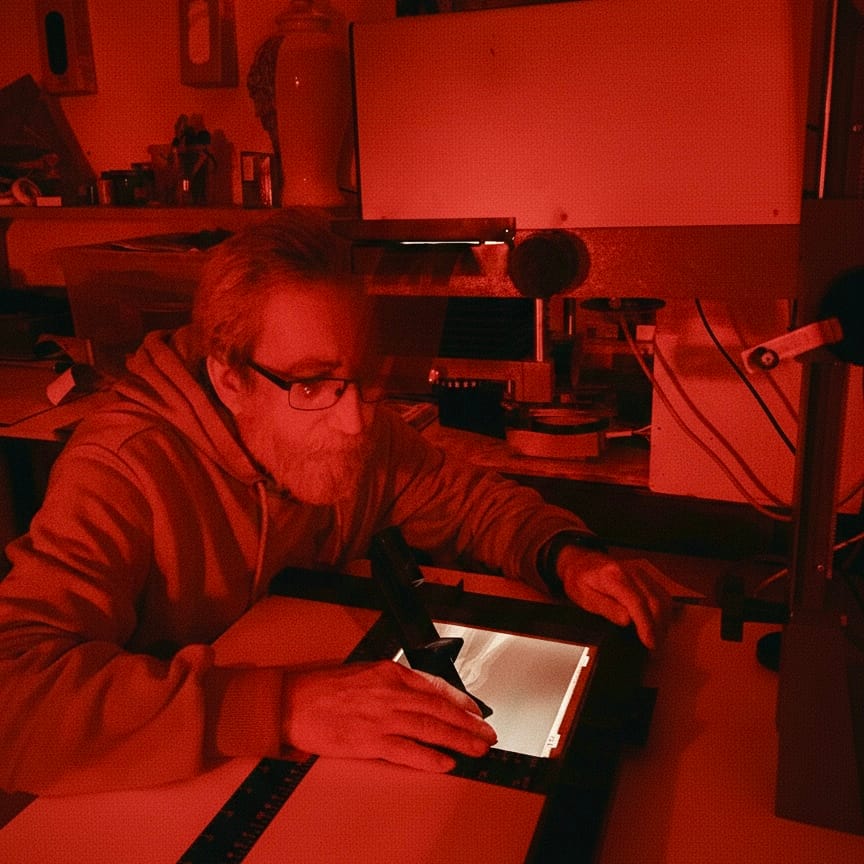
The darkroom smells like chemistry and patience.
Developer has a faint metallic sharpness — not unpleasant, but unmistakable. Fixer is sulfurous, slightly sharp, the smell that tells you a print is being made permanent. Running water is the only constant sound, steady and indifferent, rinsing silver from paper, carrying chemistry away.
You cannot photograph the darkroom. By definition, a camera would need light.
So let me try to describe it instead.
Darkness That Isn’t Quite Dark
The safelight is amber-red, just bright enough to see by, too dim to read. Your eyes adjust slowly. After a few minutes, you begin to see clearly — but in a different way than in daylight. Edges soften. Depth is harder to judge. Everything is the color of an old film photograph.
The enlarger is the focal point of the room. It stands above the paper easel like a small tower — a lens at its base, the negative carrier in the middle, the lamp housing at the top. When I switch it on, a white rectangle of light appears on the easel below.
I focus by eye, adjusting the lens until the grain of the negative is sharp. The grain of the negative — not the image itself, but the silver particles that carry it. When the grain is sharp, the image will be sharp.
Then the test strip. A narrow band of paper exposed in stages: three seconds, six, nine, twelve. Each section receives a different amount of light. After development, I read it like a map — this section too dark, that one too pale, this one right. The correct exposure is hidden inside that strip, waiting to be found.
When the Image Arrives
The actual printing is a ritual.
I cut a full sheet of paper in the dark — by feel, knowing the size by the dimensions of the easel. I lay it flat, expose it, then move it to the developer tray in a single smooth motion.
Sixty seconds, agitating gently, rocking the tray so the chemistry stays active across the whole surface.
And then the image arrives.
It does not appear all at once. First, the deepest shadows — the blacks that will anchor the composition. Then the midtones build slowly, and finally the highlights emerge last and most faintly. The whole process takes perhaps forty-five seconds, and I watch all of it.
Every time, it feels like something is being recovered rather than made.
The print goes into stop bath, then fixer, then the wash tray where water runs continuously. Each print washes for at minimum forty-five minutes. This is not optional — gelatin silver prints that are not washed thoroughly will yellow within years. The washing is the part no one sees and the part that determines whether a print lasts a decade or a century.
Concentration Without Urgency
Working in the darkroom is one of the few activities that demands total focus without producing stress.
There is nothing to optimize, no metric to improve. There is only this print, this moment, this combination of light and chemistry and judgment. If I rush, the print suffers. If I wait too long, the developer exhausts. The process dictates the pace, not the other way around.
I have spent entire days in the darkroom. I have come out to find that five hours had passed and felt like ninety minutes.
There is a particular kind of tiredness that comes from work that required full attention — not the hollow exhaustion of distraction, but something that feels earned. On good days in the darkroom, I carry that tiredness home and it sits with me quietly, like a satisfaction.
The red light goes off. The tray stops rocking. The print dries on the line.
What comes out of the darkroom is not a file. It is not a copy of something. It is the thing itself — silver on paper, permanent, unique, made slowly in the dark.